
Boundary Wire vs Wire-Free Robot Lawn Mowers
Both systems can work extremely well. The better choice depends less on which technology is newer and more on your lawn layout, signal conditions, budget, and how often you expect the garden to change.
Neither system is automatically better
A boundary wire robot lawn mower is often the sensible choice when the lawn layout is stable, you want proven technology, and you do not mind installing a physical perimeter cable.
A wire-free robot lawn mower becomes more attractive when you want to edit mowing zones digitally, create flexible no-go areas, or avoid installing a perimeter wire in the lawn.
The important caveat is that wire-free does not describe one single navigation system. Different models can use RTK positioning, cameras, LiDAR, satellite positioning, onboard sensors, or a combination of technologies. How well a system fits your garden can therefore matter more than whether the box simply says wire-free.
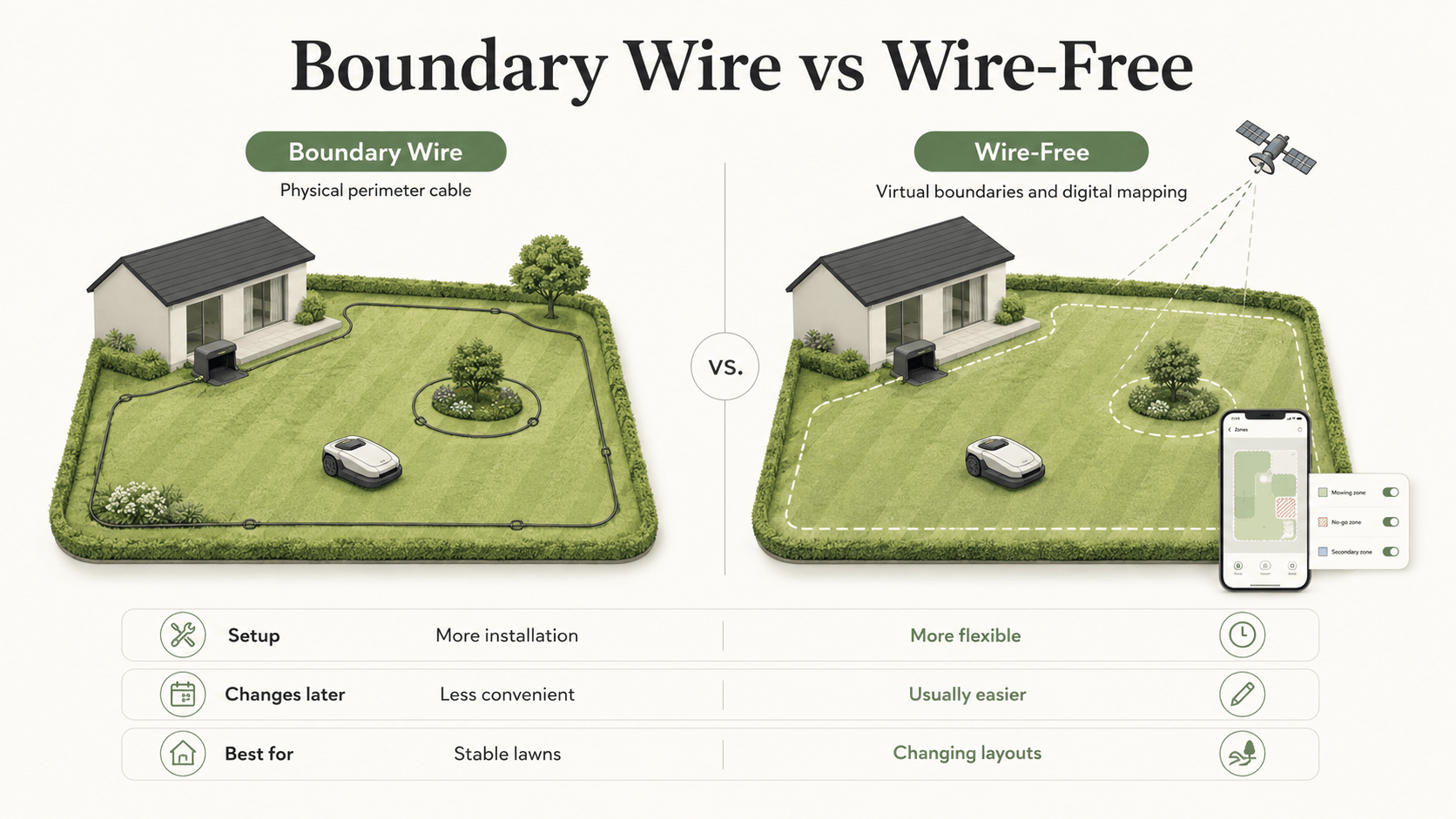
Physical boundary vs digital boundary
Both systems ultimately solve the same problem: telling the robot where it is allowed to mow. The difference is how that boundary is created and maintained.
| Factor | Boundary wire | Wire-free |
|---|---|---|
| Boundary | Physical cable around the mowing area | Digital or sensor-defined mowing area |
| Initial setup | More physical installation | Usually more mapping and app setup |
| Changing zones | May require moving or adding wire | Often editable digitally |
| Satellite dependence | Generally not required for the boundary | Depends on the navigation system |
| Garden changes | Less convenient to modify | Usually more flexible |
| Best fit | Stable layouts and buyers who value proven simplicity | Flexible layouts and users who value digital control |
How boundary wire robot lawn mowers work
A boundary wire system uses a cable installed around the edge of the mowing area. The mower detects the signal from the wire and uses it to remain inside the lawn.
The wire can normally also be used to exclude flower beds, landscaping, ponds, or other areas where the mower should not enter.
It is established technology, and that maturity still matters. A correctly installed boundary wire can create a very predictable mowing area without requiring the mower to determine the lawn edge from satellite positioning or vision alone.
Where boundary wire makes sense
- Your lawn boundaries are unlikely to change frequently.
- You are comfortable spending more time on the initial installation.
- You prefer an established navigation concept over having the newest system.
- Your garden has areas where satellite-based positioning could potentially be difficult.
- You do not need to regularly redraw mowing zones or temporary no-go areas.
Boundary wire usually shifts the inconvenience toward the beginning: installation takes more work, but the mowing boundary itself can then remain very consistent for years.
What can become frustrating?
The physical cable is also the system's biggest weakness. Garden redesigns can mean adjusting the wire, and a damaged cable may require troubleshooting before the mower can operate normally again.
If you regularly move flower beds, redesign lawn edges, create seasonal zones, or simply want to change the mowing map from your phone, the fixed nature of the wire becomes less attractive.
How wire-free robot lawn mowers work
Wire-free systems replace the physical perimeter cable with digital mapping, positioning technology, environmental sensing, or a combination of these methods.
The exact technology matters. One mower might rely heavily on RTK positioning, while another may combine cameras, sensors, LiDAR, or other localisation methods.
This is why two robot mowers can both be marketed as wire-free yet behave very differently in the same garden.
Where wire-free makes sense
- You want to avoid installing a physical perimeter cable.
- You expect the mowing area to change over time.
- You want to create or edit no-go zones digitally.
- Your lawn has multiple areas that benefit from flexible zone management.
- App-based control and easier map changes are important to you.
Removing the physical cable does not remove every installation consideration. Trees, buildings, walls, narrow spaces, camera visibility, satellite reception, and the mower's specific navigation technology can still affect performance.
The real advantage is flexibility
The biggest practical benefit is not simply that there is no cable. It is that many wire-free systems make the lawn map much easier to change later.
Adding a temporary no-go area, changing a mowing zone, or adjusting a boundary can be significantly easier when those changes are made digitally instead of physically altering buried or pegged wire.
Which setup fits your lawn?
Start with the garden rather than the technology. These three situations cover many of the practical differences between the two approaches.
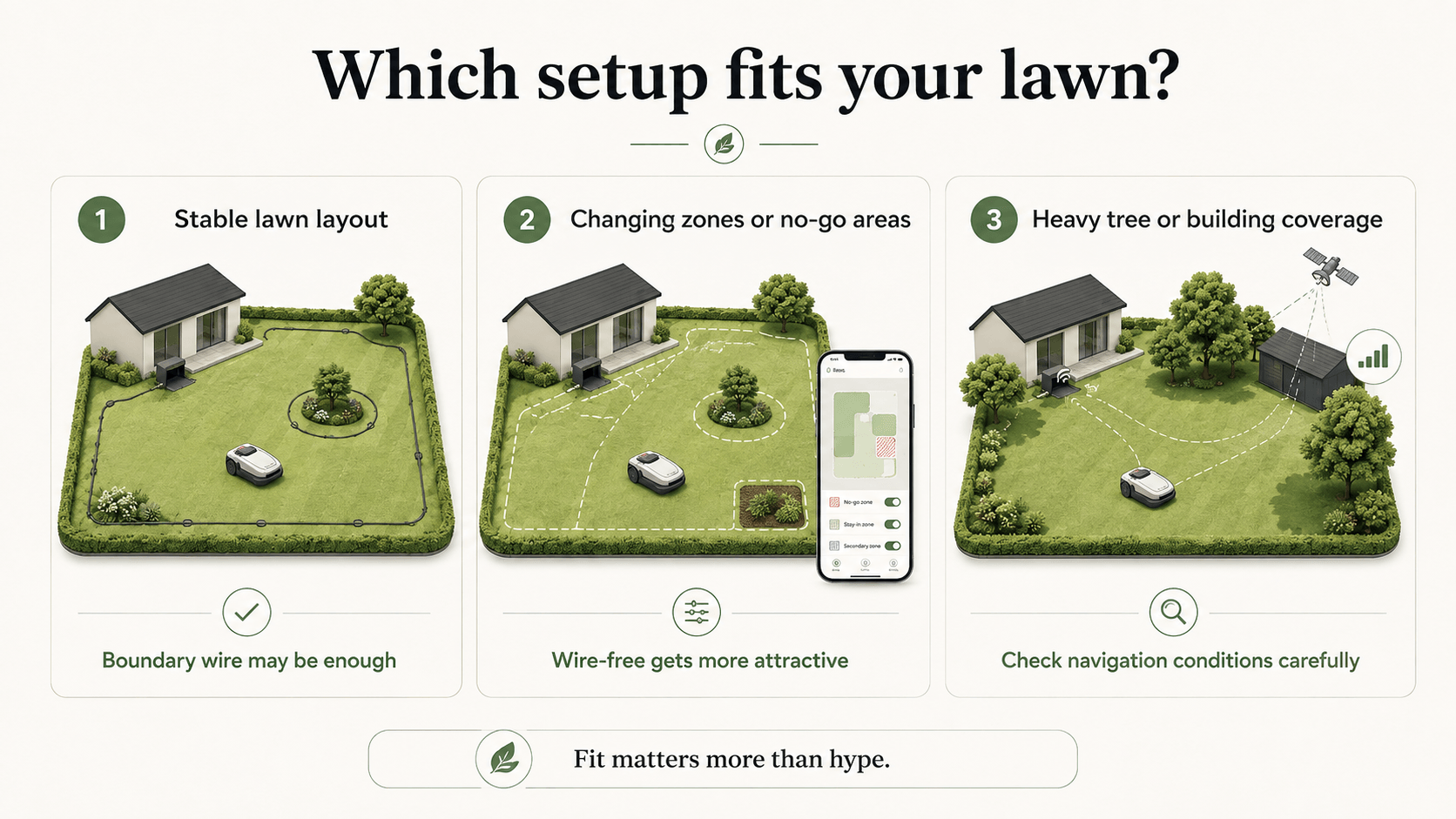
Boundary wire may be enough
If your lawn edges and excluded areas rarely change, a physical boundary can remain a practical long-term solution.
Wire-free becomes attractive
Digital boundaries make more sense when zones, garden beds, or no-go areas need regular adjustment.
Check navigation first
Heavy tree cover, buildings, walls, and narrow spaces make the mower's actual positioning technology especially important.
Six things that matter more than the label
Boundary technology is only one part of robot mower suitability. A mower still needs to fit the lawn itself.
Lawn size
Check whether the mower has realistic capacity for your actual mowing area, not just whether it is wired or wire-free.
Slopes
Maximum slope capability and traction can become hard limits regardless of which boundary system the mower uses.
Narrow passages
Complex connections between lawn zones can challenge navigation, so check the mower's minimum passage requirements.
Trees and buildings
They can matter particularly for systems that rely heavily on satellite positioning or clear visual navigation.
Separate mowing zones
Multiple lawn areas, paths, and disconnected sections can make flexible mapping more valuable.
Future garden changes
A lawn that looks simple today may not stay that way. Consider whether you expect new beds, landscaping, or seasonal no-go areas.
Start with what you value most
Fit matters more than hype
We do not consider boundary wire inherently outdated, and we do not consider wire-free navigation automatically superior. Both can be the right answer.
The better system is the one that works with your lawn size, terrain, layout, obstacles, navigation environment, and expectations. Technology should solve the garden's problems rather than create new ones.
That is also how MowCompass approaches mower recommendations: hard lawn requirements come before features, price, or retailer links.
Still not sure which mower setup fits?
Instead of choosing by navigation technology alone, use the MowCompass Robot Lawn Mower Finder to narrow the options using lawn size, terrain, garden layout, and setup preferences.
MowCompass prioritizes product fit before commercial relationships.
Boundary wire vs wire-free robot mower questions
Is a wire-free robot lawn mower better than boundary wire?
Not automatically. Wire-free systems usually offer easier boundary changes and more flexible digital zones, while boundary wire systems can offer a very predictable fixed mowing area. The better option depends on the lawn and the mower's actual navigation technology.
Are boundary wire robot lawn mowers outdated?
No. Boundary wire remains useful when you want a fixed and established mowing boundary and do not expect to change the garden layout frequently.
Do all wire-free robot mowers use GPS?
No. Wire-free is a broad category. Depending on the model, the mower may use RTK positioning, satellite positioning, cameras, LiDAR, onboard sensors, or several technologies together.
Can trees cause problems for wire-free robot mowers?
They can affect some navigation systems more than others. Dense tree cover or nearby structures may influence systems that depend heavily on clear satellite reception, while other navigation technologies may respond differently. Check the specific mower rather than assuming all wire-free models behave the same way.
Is boundary wire difficult to install?
Installation takes more physical work because the wire must define the mowing perimeter and any excluded areas. The benefit is that once the layout is correct, it can remain in place for a long time.
Which system is better if I change my garden often?
Wire-free systems are usually more convenient when mowing zones and no-go areas need regular changes because those boundaries can often be edited digitally instead of moving physical cable.
What should I check before buying either type?
Check lawn size, maximum slope, narrow passages, separate zones, obstacle complexity, navigation conditions, charging-station requirements, and how often the garden layout is likely to change.
Choose for your lawn, not the technology label
Tell MowCompass about your lawn size, terrain, layout, and setup preferences. The Finder can then narrow the field to robot mowers that better match those conditions.
Start the Robot Lawn Mower Finder